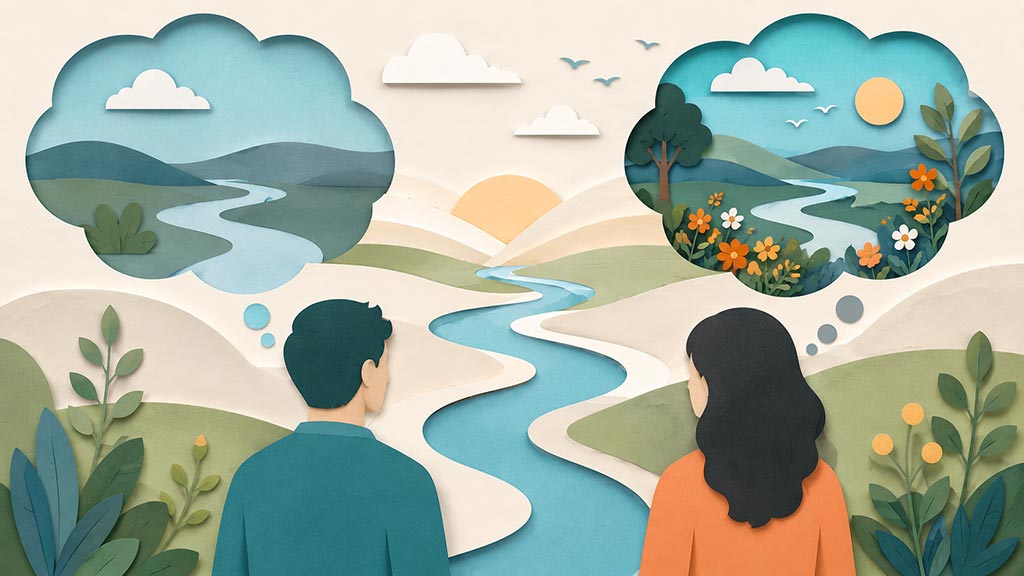
Picture two individuals standing by the same river.
One notices the water.
The other notices not just the water, but also the reflections, the shifting light, the scent left by yesterday’s rain, birds hiding in the reeds, and a quiet feeling that the river brings back childhood memories.
They stood in the same spot. But did they really experience the same river?
We often think that everyone shares events in the same way.
Someone says something. A meeting takes place. A relationship ends. A child comes home from school. A stranger smiles. Music starts to play. It seems obvious that we all experience the same event.
But maybe we don’t.
The Invisible Part of Every Experience
When we talk about something that happened, we usually just describe the event itself.
Someone criticised me. We watched the sunset. We went to a wedding. My friend didn’t reply.
Those are just the facts. But an experience is always more than that.
An experience includes everything that touched us.
The words.
The tone.
The atmosphere.
The memories it awakened.
The hopes it stirred.
The fears it touched.
The possibilities we imagined.
The beauty we noticed.
The meaning we quietly gave it.
Two people can see the same event but have completely different experiences.
A Concert
Picture two friends at the same concert. One enjoys the music, claps at the end, and goes home happy. The other can’t stop thinking about one song. It reminds them of someone they loved, brings back old memories, and leaves them feeling quiet for days.
Which person experienced the concert correctly?
Neither.
Both did, just not in the same way.
A Conversation
A manager gives the same feedback to two employees.
One thinks, “That’s useful. I’ll improve that next time.”
The other spends the evening replaying every word, worrying they might have let everyone down.
The words were the same, but the experience was not.
A Walk
A family walks in the woods. One person enjoys the exercise. Another notices a feather on the path, the changing colours, the quiet between birdsong, the smell of pine, an old tree growing sideways, and a tiny spider’s web shining in the morning light.
Neither person is walking correctly.
The world just reaches each of them in a different way.
We Often Judge the Wrong Thing
This is often where misunderstandings start.
We notice how someone reacts, but we don’t see what actually reached them.
Someone might seem too emotional, too distant, too sensitive, too careless, too serious, too dramatic, or too cold. But maybe we’re judging their reaction without knowing what they actually experienced.
It’s a bit like watching two people carry different weights and deciding which one is weaker.
We see the effort, but we never know the weight they’re carrying.
The Same World?
This idea can quietly change a lot of our assumptions.
Maybe your friend isn’t ignoring what upset you. Maybe it just didn’t reach them in the same way.
Maybe someone who seems calm isn’t actually stronger. Maybe they just had less to carry.
Maybe what made you tired wasn’t just ordinary life. Maybe ordinary life just reached you in a different way.
Looking Again
Once we start to see this, it becomes harder to judge others.
Instead of asking, “Why are they like that?”
we begin asking, “What might this experience have been like for them?”
And instead of asking, “Why am I so different?”
we begin asking, “What actually reached me?”
It’s a small shift in perspective, but it opens up a whole new way of understanding ourselves and others. Maybe people aren’t just reacting differently to the same world. Maybe, in many quiet ways, we have never been living in quite the same world at all.