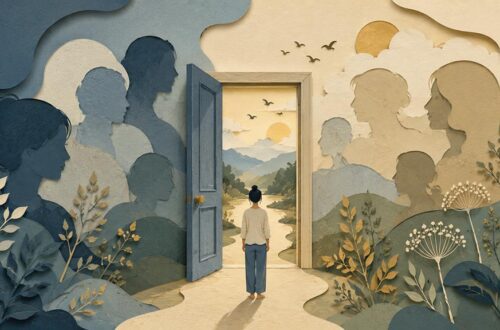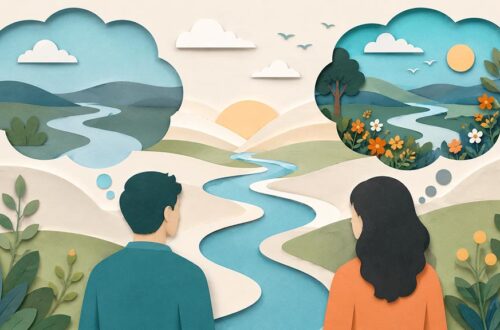
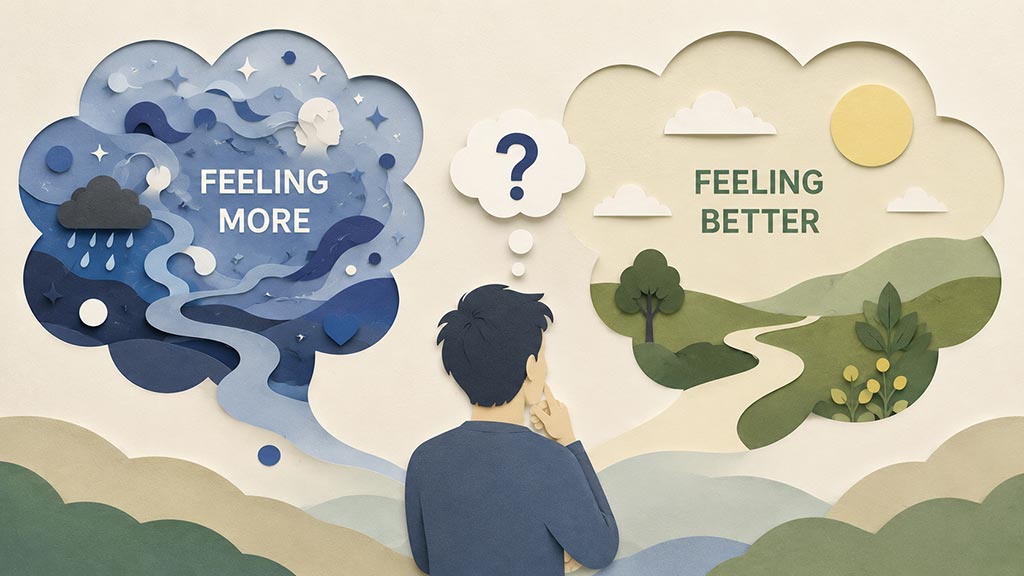
Imagine standing on top of a mountain. From there, you can see much further than someone standing in the valley. You notice distant hills, changing weather, rivers winding through forests, and villages beyond the horizon.
Being able to see further is a gift, but it does not always make life easier.
You also see the approaching storm long before anyone else. You notice the smoke rising from a distant fire. You see how many paths are possible. Sometimes you even see problems that never arrive.
When you see more, your experience changes, but it does not always get better. Maybe feeling works in a similar way.
More Isn’t Always Better
When people first discover the idea of Feeling Range, they often ask the same question. “So is a wider Feeling Range better?”
This is a reasonable question. We often believe that having more of something is always better—more intelligence, confidence, creativity, empathy, or awareness. So it seems natural to think that more feeling would be better too.
But life does not usually work like that. A wider Feeling Range brings new possibilities, but it also brings new challenges.
More Beauty. More Pain.
Someone with a wide Feeling Range may be deeply moved by music. They may notice quiet beauty that others walk past. A simple conversation may stay with them for years. They may feel profound joy watching a child laugh or the evening light fall across a river.
These are genuine gifts.
But this same openness can also make disappointment last longer. Conflict can feel stronger. Loss can feel deeper. Beauty can stir up longing. An ordinary day might simply hold more. The openness that lets in joy also lets in sorrow.
You cannot choose one without making room for the other.
Less Isn’t Less Human
It is easy to think that someone who feels less must care less, but that is not true.
Some people go through life in a simpler way. They bounce back quickly after disappointment and enjoy what is in front of them without holding onto it for weeks. They might not notice every small change in a relationship, but they can still love deeply, stay loyal, work generously, protect their family, laugh fully, and live meaningful lives.
Feeling things differently does not make anyone less human.
Different Gifts
A broad awareness often helps us see connections, while a narrower awareness can bring clarity.
Someone who sees many possibilities might hesitate before deciding, while someone who sees fewer options may act with more confidence.
Neither way is wiser or shallower. Each has its own strengths. This is true in nature as well.
A wide river carries more water.
A narrow stream moves more quickly.
Neither is trying to become the other.
The Trap of Comparison
Many people spend years wishing they were different.
Sensitive people sometimes wish they could turn off their feelings, while others wish they could feel more deeply. Both are comparing themselves to others. But this kind of comparison assumes there is only one right way to experience life.
Maybe there is not just one way. Maybe life asks something different from each of us—not to live someone else’s experience, but to understand our own.
A Better Question
Instead of asking, “Is my Feeling Range good?”
or “Is theirs better?”
perhaps we can ask, “What kind of life does my Feeling Range invite me to live?”
Asking this question changes everything. It turns judgement into curiosity, comparison into understanding, and envy into responsibility.
Not Better. Just Different.
The purpose of Feeling Range is not to rank people or to act as another personality test. It is not meant to divide people into stronger or weaker, deeper or shallower.
Its purpose is much quieter.
It helps us stop fighting the way we experience life, appreciate the gifts it brings, recognize its challenges, and start building a strong center that can hold whatever our experience brings.
Because the goal was never to feel more. Or to feel less. It was always to live well with the life that reaches us.