Why Sensitive People Lose Themselves: A Self-Test
Some people feel widely. They notice moods, shifts, silence, tension, disappointment, and emotional pressure before anyone says a word. They are often thoughtful, caring, intuitive, and deeply affected by the world around them.
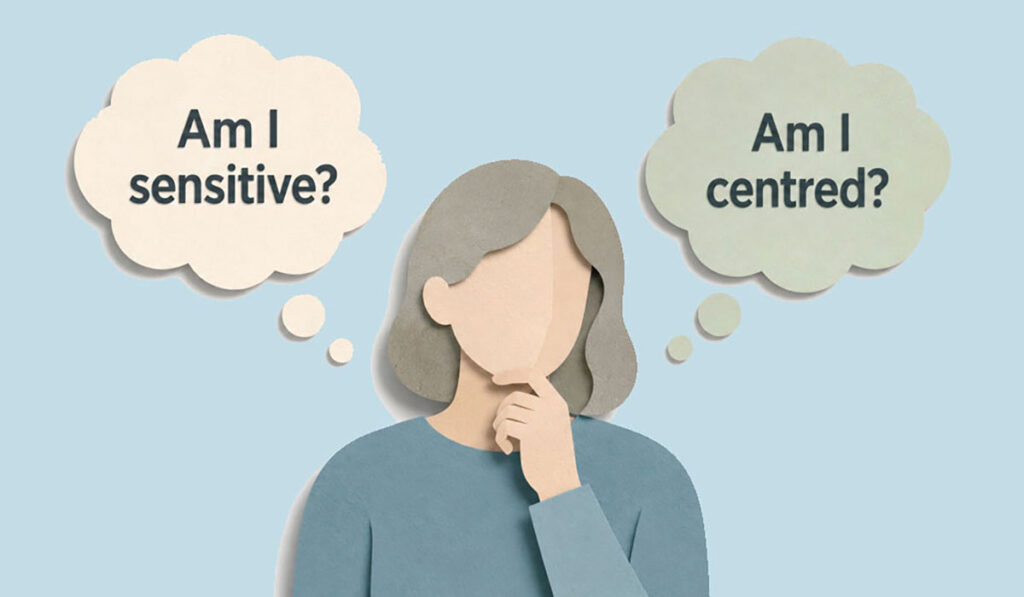
But feeling widely alone is not the whole story, and the real question is not only this:
How sensitive am I?
It is also:
Do I have a centre strong enough to remain myself while feeling so much?

The Self-Test
For each statement, choose the answer that feels most true.
Use this scale:
0 — Rarely true
1 — Sometimes true
2 — Often true
3 — Very true
Part One: Sensitivity
This section looks at how widely and deeply you feel.
- I often notice the mood in a room before anyone says anything.
- I can sense disappointment, tension, or withdrawal in someone’s voice or behaviour.
- I am affected by other people’s emotional states, even when they are not directed at me.
- I often think about what someone else might be feeling underneath what they are saying.
- I find it hard to ignore emotional atmosphere, even when I try to focus on something else.
- I may carry an interaction with me long after it has ended.
- I often feel the meaning behind small details, gestures, pauses, or changes in tone.
- I can feel deeply moved by beauty, kindness, sadness, conflict, or someone else’s pain.
- I often understand why someone behaves as they do, even when their behaviour affects me negatively.
- I need time to process emotional experiences after they happen.
Sensitivity score:
Add your answers for questions 1–10.
Possible score: 0–30
Part Two: Centre
This section looks at whether you can remain connected to yourself while feeling and understanding so much.
- When someone is upset, I can pause before assuming it is my responsibility to fix it.
- I can understand someone’s pain without excusing behaviour that harms me.
- I can sense emotional pressure without immediately bending to it.
- I can say no even when I understand why someone wants me to say yes.
- I can stay aware of what I want, even when someone else has strong needs or emotions.
- I can care about someone without losing the direction of my own life.
- I can notice guilt without automatically obeying it.
- I can let someone be disappointed without immediately abandoning my own boundary.
- I can feel deeply and still ask, “What belongs to me here?”
- I can stay open without becoming overrun.
Centre score:
Add your answers for questions 1–10.
Possible score: 0–30
Your Results
This self-test is not a diagnosis, nor is it meant to place you in a fixed box. It is more like a mirror, help you to notice two things:
How much enters you — your sensitivity.
How well you stay with yourself — your centre.
For both Sensitivity and Centre, use this guide:
0–10: Low
11–20: Moderate
21–30: High
You might see yourself clearly in one of the four patterns below, or somewhere in between. This is very natural. Most of us are not just one simple type in every situation. You may feel centred at work but lose your ground in family relationships. You may feel steady with friends, but become more absorbent with a partner. Sensitivity can also rise during times of grief, stress, conflict, or major change.
So let these patterns be gentle suggestions. Look for what feels familiar, rather than a perfect fit.
Pattern 1. High Sensitivity, Low Centre — The Absorber
Sensitivity: 21–30
Centre: 0–10
You feel widely and deeply, and it can be easy to lose yourself inside what you feel.
You quickly notice moods, tension, disappointment, and emotional pressure. Because you can understand people so well, you can also take too much, bend too quickly, or take responsibility for what was never yours to carry.
You may often ask yourself:
- Why do I feel responsible for everyone’s feelings?
- Why do I understand others so easily, but struggle to hear myself?
- Why do I keep helping other people move forward while my own life stalls?
From the outside, this pattern may appear to be kindness, patience, empathy, or emotional intelligence. Inside, it can feel like exhaustion, confusion, resentment, invisibility, or a quiet loss of direction.
The invitation is not to become less sensitive, but to build enough centre that your sensitivity does not turn into self-abandonment.
Practise this: before responding to emotional pressure, pause and ask:
What am I feeling, and what is actually mine here?
Pattern 2. High Sensitivity, Strong Centre — The Centred Feeler
Sensitivity: 21–30
Centre: 21–30
You feel widely, and you are learning to stay with yourself.
You may notice emotional atmosphere, sense what is unspoken, and understand others deeply. But you are also able to pause, discern, hold boundaries, and choose your response without immediately disappearing into someone else’s need, mood, or expectation.
This is mature sensitivity. This does not mean you are never affected or always calm. It means that even when much enters you, you are growing an inner place that can remain present. You still feel deeply, but feeling does not automatically become obedience, and you care deeply, but care does not automatically become self-loss.Your sensitivity becomes guidance, creativity, compassion, and wisdom, especially as you learn that you do not have to carry everything alone.
Practise this: keep strengthening the pause between feeling and action, and ask:
What is this feeling showing me, and what response truly belongs to me?
Pattern 3. Low Sensitivity, Strong Centre — The Steady One
Sensitivity: 0–10
Centre: 21–30
You do not take in as much of others’ emotional atmosphere, and it feels easier to stay grounded, make decisions, and hold boundaries. This can be a real strength, for you are less easily pulled by guilt, mood, tension, or other people’s disappointment, you recover more quickly after difficult interactions, and you often find it easier to separate your own direction from the emotional field around you.
Here, the invitation is to stay connected to care.
Though low disturbance can look like clarity, it can also miss what others are carrying. Steadiness may become distance, and a strong centre may become a wall if it loses touch with empathy. Your work may be to ask:
- Am I centred, or am I simply unaffected?
- Am I clear, or am I missing emotional information?
- Can I stay grounded while becoming more attuned?
Practise this: before deciding that something “is not a big deal,” pause and ask:
What might this feel like for the other person?
Pattern IV. Low Sensitivity, Low Centre — The Unanchored Drifter
Sensitivity: 0–10
Centre: 0–10
You may not always notice emotional complexity right away, or sense the subtle moods and unspoken layers in a situation. When pressure does reach you, it can feel unclear how to respond. You might avoid conflict, withdraw, become defensive, follow the strongest voice in the room, or let other people’s certainty override your own. This pattern is not about feeling too much. It is more about not yet having a clear sense of your own inner position.
You may ask yourself:
- What do I actually feel?
- What do I really think?
- Why do I let other people decide the emotional direction of a situation?
- Why do I go along with things and only understand myself later?
Your work may begin with both awareness and grounding: learning to notice more of what is happening, while also building a clearer relationship with yourself.
Practise this: after an interaction, take a moment and ask:
What did I feel? What did I want? What did I agree to before I knew my own truth?
If Your Scores Are Moderate
Many people will find themselves scoring between 11 and 20 in one or both areas. This is not a problem. It simply means your pattern may shift depending on the relationship, environment, stress level, or season of life.
For example:
High Sensitivity + Moderate Centre
You feel widely and have some grounding, but stronger emotional pressure can still pull you away from yourself.
Moderate Sensitivity + Low Centre
You may not feel everything deeply, but certain people or situations can still make you lose your ground.
Moderate Sensitivity + Strong Centre
You may be generally steady, but you might still want to develop more emotional attunement or trust in subtle feeling.
Instead of trying to force yourself into one category, you might ask:
- Where do I recognise myself most clearly?
- Where do I lose myself most often?
- Which pattern appears when I am tired, pressured, guilty, afraid, or trying to keep peace?
A Simple Reflection
After taking the test, sit with these questions:
- Where do I feel most wide?
- Where do I most often lose myself?
- What kind of emotional pressure pulls me away from my own centre?
- Do I confuse understanding with obligation?
- Do I confuse kindness with self-abandonment?
- Do I feel responsible for feelings that are not mine to carry?
- What would it mean to care without disappearing?
You do not need to answer everything at once. Let one question linger with you for a while.
The Core Idea
Sensitivity is not the problem. Feeling deeply is not the problem. The difficulty begins when sensitivity has no centre.
Without a centre, sensitivity can turn into service to everyone else’s life. You may become the one who understands, adjusts, forgives, absorbs, and bends, while your own life grows quieter in the background.
With a centre, sensitivity becomes guidance. You can feel without obeying every feeling. You can understand without excusing everything. You can care without leaving yourself behind. You can stay open without being overrun.
The work is not to harden or to care less. The work is to stay present while caring deeply.
Keep the range. Build the centre.