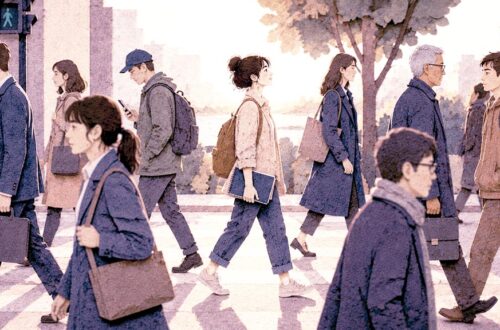

Certain people mainly experience the things that happen to themselves, while others are greatly influenced by events that take place outside of their own lives—for example, a story reported in the news, the sadness of a stranger, the quiet tension between two people across the room, a child they have never met, or a forest on the other side of the world.
One person reads the story and moves on whereas another person keeps thinking about it for the rest of the day.
Part of the answer may be Reach.
How Far Does Your Heart Go?
Picture two individuals who are both reading the same news article concerning a family being driven from their home due to war. The first experiences a feeling of sadness for a while before getting back to their normal routine, while the second is unable to stop picturing the children and finds themselves thinking about where the children had slept, whether they had been frightened and whether someone had remembered to take their favourite toy.
The identical story was received by two different individuals, but it covered very different distances. That is what I mean by Reach.
Reach poses a simple question: How far do your feelings naturally extend beyond yourself?
Some Feelings Stay Close to Home
Many of us care most of all about the people we know—our family, our friends, the people we work with, and our own pleasures and difficulties. It is not at all wrong to do so; in this way we are able to direct our energy to the areas of life that demand the most of us.
With some people, however, the feeling doesn’t end there. Their concern extends beyond their own circle and they pick up on the atmosphere in a room, noticing the loneliness of a stranger and the quiet suffering that is hidden behind someone’s smile.
They can be influenced by individuals whom they’ll never meet, not since they have made the choice to do so, but merely because that’s the way their emotions work.
The Hidden Weight
A wide Reach may be beautiful since it opens the way to compassion, to tenderness, and to seeing the connections that others might fail to see. However, it also comes at a cost.
The more your feelings extend, the more of the world you take in. A distant tragedy ceases to seem distant. When a friend has a problem it becomes hard to ignore. You start to consider consequences even though no one else appears to be concerned about them. There are sometimes things you carry which were never yours to carry. This is not because you’re attempting to save the world. Rather, it is because your heart has a natural tendency to reach out further.
Caring Isn’t the Same as Carrying
A common misapprehension regarding Reach is the idea that caring involves taking on responsibility.
It doesn’t.
It is possible to care a great deal without feeling obliged to fix all the issues, and you can allow someone’s suffering to affect your heart without letting it control your life.
The problem is not about reducing your Reach; it is about giving it a solid centre.
A place that quietly reminds you: Not every pain I can feel is mine to carry.
A Different Way to Understand Others
Reach also explains many everyday misunderstandings.
One person asks, “How can you not care?” The other genuinely doesn’t understand what they’re expected to feel.
Neither person is necessarily lacking compassion. Their feelings simply travel different distances.
When we start to understand this, we no longer judge everyone according to our own emotional map and instead become interested in the various worlds that people are living in.
A Wider Heart Needs Stronger Roots
Having a wide reach has nothing to do with becoming more emotional or a better person; it is merely one way human beings are different.
Some hearts stay close to home. Others wander further. Neither is enough on its own.
A heart that extends itself over a great distance also needs strong roots; otherwise, each sorrow will be felt personally, every difficulty will be our own, and every distant storm will enter our garden.
The aim is not to close your heart but to allow it to extend over a wide area without giving up the place it considers to be home.