There is a moment many parents know well.
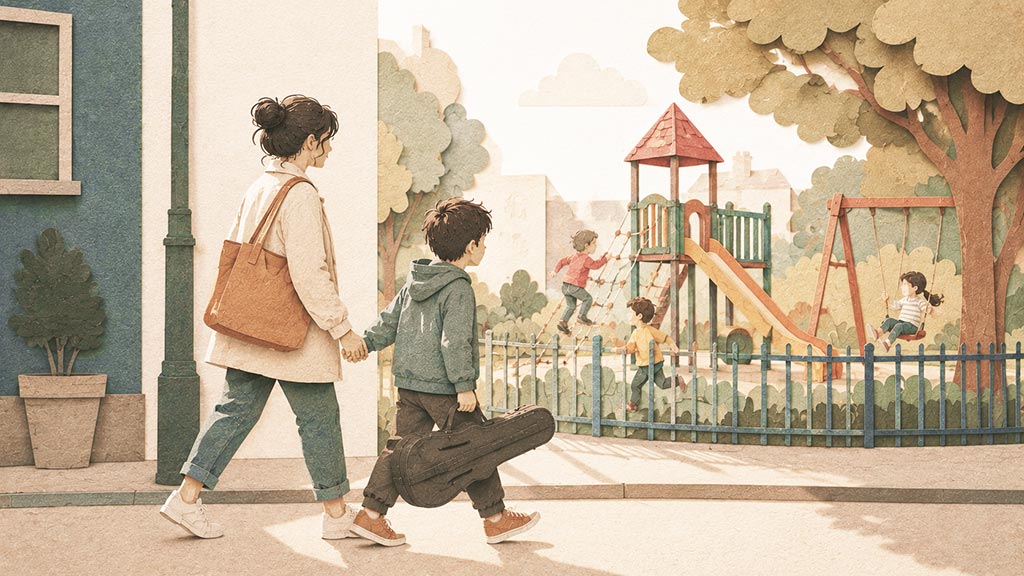
You are walking with your child towards something important. School. A music lesson. A family gathering. You are thinking about arriving on time. Remembering what still needs doing.
Planning the rest of the day.
Meanwhile, your child has stopped.
They’re watching a butterfly.
Listening to a busker.
Staring through the fence at children playing football.
You’re walking the same road.
But you’re not travelling through the same world.
We Expect More Similarity Than Actually Exists
Parents naturally look for themselves in their children.
We smile when they share our interests.
We worry when they don’t.
Sometimes we quietly assume they should experience life much as we do.
Yet no two Feeling Ranges are exactly alike.
Even brothers and sisters raised in the same home can experience the world in remarkably different ways.
One notices every change in mood.
Another barely notices.
One is deeply affected by criticism.
Another lets it pass.
One needs quiet after school.
Another needs company.
Neither child is more normal.
They simply have different inner worlds.
The Same Childhood Isn’t the Same Experience
Parents often say,
“But we grew up in the same family.”
Or siblings say,
“How can you remember it so differently?”
Because childhood isn’t only made from events.
It is made from how those events were experienced.
The same home.
The same parents.
The same dinner table.
The same holiday.
Yet each child notices different things, absorbs different emotions and carries different memories forward.
There isn’t one childhood.
There are as many childhoods as there are children.
Looking Beyond Behaviour
As parents, it’s easy to focus on behaviour.
Why won’t they listen?
Why are they so sensitive?
Why don’t they seem to care?
Why are they always asking questions?
Feeling Range invites a different question.
What might life feel like from where they are standing?
Suddenly behaviour becomes less mysterious.
Perhaps your child isn’t being difficult.
Perhaps the classroom feels louder than you imagine.
Perhaps disappointment lasts much longer inside them.
Perhaps they notice tensions in the family that no one has spoken about.
Or perhaps they simply experience joy more intensely than you ever did.
Behaviour is often the visible surface of an invisible experience.
Parenting Becomes More Curious
One of the greatest gifts we can give our children isn’t constant advice.
It’s curiosity.
Instead of asking,
“Why are you like this?”
we begin asking,
“Help me understand what this feels like for you.”
Children don’t always have the words.
Sometimes they answer through silence.
Sometimes through tears.
Sometimes through play.
Sometimes years later.
But asking the question changes the relationship.
It tells them,
Your experience matters, even when I don’t fully understand it.
They Are Not Me
Perhaps one of the hardest lessons in parenting is accepting that our children are not unfinished versions of ourselves.
They are not here to complete our dreams.
Nor to repeat our lives.
They bring their own ways of seeing.
Their own questions.
Their own gifts.
Their own Feeling Range.
Our role is not to shape them into ourselves.
It is to help them discover who they already are.
Growing Together
Something unexpected happens when we begin seeing our children this way.
We become gentler.
Not because parenting becomes easier.
But because we stop expecting sameness.
Instead of trying to make them experience the world as we do…
we begin exploring the world they already inhabit.
And perhaps that is one of the quietest gifts of parenting.
Not raising children who become like us.
But learning, through them, that there are many beautiful ways to experience the same life.